The Truth:
The Quran, Hadith and Sira paint a picture of Islam and the life of
Muhammad that is unsavory in the modern age. Because of this, Islam's apologists prefer
that non-Muslims "learn" about the religion from people who agree
with it and can make it
sound appealing by dismissing the bad parts while exaggerating (or inventing) the good.
Of course, they can't come out and say this. What they say instead is that Islam can
only by taught by Muslims.
Much like the debunked ploy that the Quran can only be understood in Arabic,
this is really just a cheap defensive strategy based on bad logic. There are no secrets in
Islam. If it can be taught, then it can be learned. If it can be learned, then
it can be taught by anyone who has learned it.
Any serious student of a subject doesn't rely on mystics and high priests for 'interpretation'. They want sources that are both
knowledgeable and objective.
While an Islamic scholar is knowledgeable, they are not necessarily objective. The average Muslim is neither.
Belief and knowledge are not the same thing.
Becoming a Muslim is as simple as repeating the shahada. How does that confer knowledge?
Consider some of the e-mail exchanges our editor has had with Muslims
who object to this website (TROP):
Muslim #1: If you were a Muslim, then you would know that it is
against Islam to kill anyone.
TROP:
Really? Because it says in verse 5:33 of the Quran that
"the punishment of those who wage war against Allah and His messenger and
strive to make mischief in the land is only this, that they should be
murdered or crucified or their hands and their feet should be cut off on
opposite sides." Does that not sound like killing to you?
(No reply)
Muslim #2: If you were a Muslim, then you would know that
the Quran says not to kill women and children.
TROP: Where does it say that?
(No reply)
Muslim #3: If you were a Muslim, then you would know Muhammad never killed a woman.
TROP: All of the Sahih hadith compilers and early biographers
say that Muhammad had women stoned to death for adultery. Doesn't that
count?
(No reply)
Muslim #4: If you were a Muslim, then you would know that terrorists
can't be Muslim because a Muslim would never kill another Muslim.
TROP: What religion were the women that Muhammad had stoned to death?
(No reply)
Imagine how conversations like this would go if, instead of a knowledgeable critic,
the Muslim "teacher" was "explaining Islam" to someone who believes that simply
being Muslim makes one knowledgeable about it. Even if the Muslim "teacher"
were sincere (and our feeling is that most are) the gullible "student" would
come away horribly misinformed on very critical matters.
Most people in any religion know only what they are told, and rarely care to question,
examine or expand on it. The Muslim who
says that "Islam means peace," for example, probably doesn't know that it
really means "submission" and that there is a separate Arabic word for
peace (salaam). More to the point, they probably don't care if they are wrong and may even
get argumentative and stubborn when told the truth.
This affirms a larger problem with learning Islam from Muslims: objectivity.
A company's salesperson may know the product well,
but they are probably not the best source for balanced and truthful information, particularly
as it relates to critical flaws and shortcomings.
Even a knowledgeable Muslim wants others to believe the best about Islam, as
they do, and has an interest in presenting the religion in the most flattering light.
Along with basic
beliefs (ie. the Five Pillars) they may offer up simple clichés about violence and peace that
sound pleasant but don't stand up well to truth (accounting for the brevity
of some of our editor's e-mail conversations).
As an example, a popular website called "Muhammad Fact Check" prominently states that one
should "Discover what True Islam is directly from Muslims." Right
next to this, however, they claim that "during his lifetime, Muhammad is not
known to have murdered anyone." By this, they apparently assume that
apostates,
consenting adults,
gays,
Jews
and critics don't count, since these
were among the hundreds of people Muhammad ordered put to death, according to Islam's own historians.
Let's use a saying of Muhammad as another example of how it isn't
always wise to trust contemporary Muslim sources for truthful information about Islam:
Throughout the Internet, one finds
this quote attributed to Muhammad: "A Muslim is one from whose tongue and
hand others are safe." (Sometimes the contributor will
say "from whom people are safe").
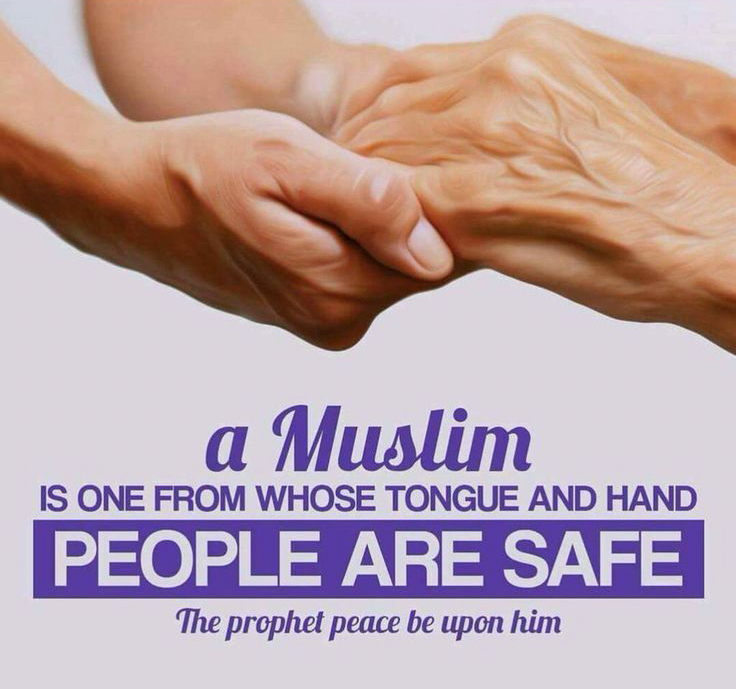 The quote sounds good, but, unfortunately,
it does not appear this way in the Sahih (authentic) Hadith,
where it is recounted several times in slightly different formats. Each verse
actually states that the
targets of decent treatment aren't "people" in general but fellow
Muslims in particular: "A Muslim is one from whose tongue and
hand other Muslims are safe." The quote sounds good, but, unfortunately,
it does not appear this way in the Sahih (authentic) Hadith,
where it is recounted several times in slightly different formats. Each verse
actually states that the
targets of decent treatment aren't "people" in general but fellow
Muslims in particular: "A Muslim is one from whose tongue and
hand other Muslims are safe."
This is more than a subtle difference, because it implies that non-Muslims are entitled to a
different sort of treatment; otherwise, why not expand the target group to include everyone?
Muslims who promote the edited (or weak) version may or may not know the truth. Somewhere along the way, however, someone did, yet decided to make it appear as if Muhamad was speaking of
universal brotherhood instead of his own identity group. They wanted to make Islam
sound appealing to non-Muslims and more in line with the Judeo-Christian ethic by shading the truth.
In fact, disingenuous tactics like these characterize most of the warm and fuzzy 'sayings of Muhammad' found in
basic Islamic propaganda, such as billboards and ads on public transportation. These are usually
weak hadith verses that have been rejected by past scholarship as non-authentic, or fragments from the Quran that are
incomplete or 'slightly reworded' to project a different meaning than what is found
in the full reading and context.
Of course, this doesn't mean that critics of Islam are immune from disingenuous tactics of their own.
However, religious people are often vested in a way
that others are not, making them more apt to believe without evidence or even dismiss
evidence a priori that is contrary to preferred conclusions.
After all, faith is considered a virtue in Islam, and those who don't "believe" are
threatened with eternal torture.
A truly objective Muslim would see the difference between what they want Islam to be and
what it really is. Instead of holding their hand over the parts they don't like,
or trying to
manufacture what isn't there out of bits and pieces, they would abandon Islam for a worldview that doesn't
require such games - or they would abandon themselves to it (a phenomenon known as "radicalization").
In most Muslim countries, skepticism and doubt are dealt with crudely (as Muhammad dictated). If you criticize Islam or
leave the faith, Islamic law calls for your death. While Muslims do not yet have the numbers
to impose Sharia in the West, deception works well as a stand-in. If Islam
is important enough to kill for, then it can certainly be lied for - particularly
to those who would otherwise be killed for not believing.
Muslim apologetics is a game of deception. It is
a constant effort to creatively obscure, with half-truth and deception, what is straightforward about Islam
and the life of Muhammad. Sometimes this involves
playing the credential card against critics, implying that truth is
determined by having a PhD or "knowing Arabic," rather than by what the Quran,
Hadith and Sira say (or don't say).
But relevancy and depth of knowledge are not necessarily the same thing. A physicist can explain why you can't walk on water, for example, but you really don't need his or her expertise to know that you can't. The Islam critic who points
out that 11 of the first 32 caliphs were murdered by fellow Muslims is providing truthful information
that is far more salient to the issue of violence than is the believing scholar who can better tell you their names
but doesn't mention their fate.
A skeptic seeks knowledge, not faith. They don't outsource critical thinking to apologists and high priests. They know that ideology and fact aren't determined by an opinion poll or what someone else says. They go straight to the source. In Islam, the source is the Quran, Hadith and Sira.
|