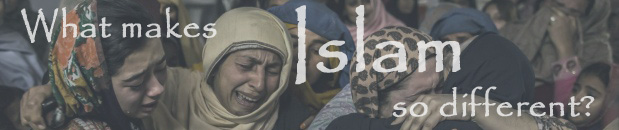
About Muslims
and Islam
"Don't judge the Muslims that you
know by Islam and
don't judge
Islam by the Muslims that you know. "
Since we hear from so many critics who
either don't take the time to read this
site, or simply can't understand the
distinction between Islam and Muslims,
we thought it best to bring together in
one place what we have said in so many
others over the years.
Islam is an ideology - a set of ideas. It is not
defined by what any Muslim wants it to
be, but by what it is. No ideology
is above critique - particularly one that
explicitly seeks political and social
dominance over every person on the
planet. Neither is it entitled to human rights, which apply to individuals.
Muslims are individuals. We
passionately believe that no Muslim
should be harmed, harassed,
stereotyped or treated any
differently anywhere in the world
solely on account of their status as a
Muslim.
As an ideology, Islam is not necessarily entitled to
equal respect and acceptance. Ideas do not carry equal moral weight.
The feelings or number of those who
believe does not make the idea true or
good. Bad ideas should be
challenged before they have bad
consequences.
Islam is not simply a belief about God.
Islam is a word that means submission.
Islam is a set of rules that
define a
social hierarchy in which Muslims
submit to Allah, women submit
to men and all non-Muslims submit
to Islamic rule.
Since we don't live in a Muslim country - where censorship, intimidation and brute force are shamelessly employed to protect Islam from intellectual analysis - we are still free to openly exercise our right to debate the merits of the Islamic value system against Western Liberalism...
- Are men really superior to women as the
Quran
says?
- Are women
intellectually inferior as Muhammad
taught?
- Does propagating material
that
curses
people
of other religions amidst random
calls to violence really make for a better social environment?
- Is it right to keep
women as sex slaves merely because the
Quran goes well out of its way to
permit this practice in numerous places?
- Should atheists and
homosexuals have to choose between the
noose and an outward
profession
of faith
in Allah?
- Is conformity superior to freedom?
Yes, there are Muslims who take issue
with these aspects of Islamic theology,
but that doesn't change what Islam is.
Don't confuse the ideology with the
individual. Don't draw conclusions
about Islam based on the Muslims that
you know, be they terrorists or
humanitarians.
Islam must be
understood on the basis of what it is,
as presented objectively in the Quran, Hadith
and Sira (biography of Muhammad).
By the same token, don't draw
conclusions about the Muslims in your
life based on the true nature of Islam.
Like any other group, not all Muslims
think alike. Even if there is no
such thing as moderate Islam it does
not mean that there are no Muslim
moderates.
If years of dialogue have taught us anything, it
is that, irrespective of their
confidence, most
Muslims have a superficial understanding of
their religion. Some are secular,
and very few
made the choice to even be Muslim.
As with
all religion, there are widely varying
degrees of seriousness with which the teachings of Islam
are taken.
As Ayaan Hirsi Ali put it, "Muslims, as
individuals, can choose how much
of their religion they practice."
For example, many Muslims in the West
do not agree with amputating limbs over theft, even
though it is plainly
mandated
in the Quran. Most simply choose
to disregard (or explain away) that which conflicts with their moral
preferences.
The Muslims that you know are not
terrorists. More than likely, their
interests in life are similar to yours
and they have the same ambitions for
their children. They should
neither be shunned, mistreated, nor
disrespected merely because of their
religion. Their property should
not be abused, and neither should copies
of the book they consider sacred be vandalized.
Prejudging an individual by their group
identity (or presumed group identity) is not only unethical, it is
blatantly irrational,
since group identity reveals nothing about
a person.
Every individual should be judged only
by their own words and
deeds.
Our advice:
Treat the ideology with caution and
candidness. Treat the Muslim with kindness, as an
individual.
Don't judge Islam by the Muslims that
you know, and don't judge the Muslims
that you know by Islam.

by
Glen Roberts, Editor of
IslamisDifferent.com
(not pictured)
|